
[Ebrun]Imagine that: when you go into a supermarket, it is a robot that greets you, introduces you the latest promotional activity; and also, it is a robot that guides you to process membership card and the electronics coupons, and collects payment from you… Those are what Sanbot can do.
Adhering to the concept of "Robotics as a Service" , Sanbot intelligent robot is a robotic product researched and developed independently by QIHAN Technology. The robot is equipped with rich perception, including touching perception, RGB image, 3D image, PIR thermoinduction, IR, voice, gyroscope and touchscreen, etc. In addition, it is capable of voice interaction, touching interaction, gesture interaction, posture interaction, mobile App mobile control, etc.; Furthermore, Sanbot can perform semantic comprehension, facial recognition, independent voice location, auto charge, intelligent safety protection and more artificial intelligence. Since its debut, the open API humanoid robots have gone into scenarios such as family, commercial chain, customs inspection, banks and the public service area.
In commercial chain area, the latest version Sanbot robot, Sanbot intelligent shopping robot can take the work of attracting consumers, advertising promotion, guidance and interpretation, cashier assistant, membership card processing, remote shop keeping and intelligent management, especially for supermarket, retail shop and related scenarios.
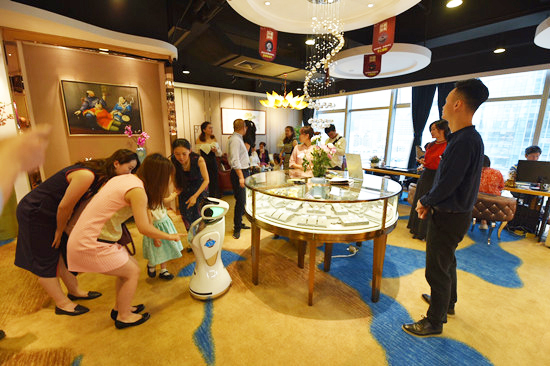
Ryan Wu, the vice president of QIHAN Technology introduced to Ebrun, “In the offline shop, it does not really help retail with their businesses if a robot only attracts customers into the shops.Thus it’s not popular, not even to promote the transformation of traditional retail business or intelligent business. But now, with the mature of technology and the integration of scenarios, robot can play a bigger and bigger role.”
In the past year, Sanbot service robots were popularly used in retail scenarios including clothing shop, jewelry shop, clock shop and other middle-high-end area. The shops might not very large but their service satisfaction is important to customers. Sanbot helped retails with questionnaire, passenger flow analysis and staff check-in services, as well as production introduction and advertising promotion. In a restaurant, supermarket or convenient store, Sanbot offered services such as dispensing electronic coupons, customer reception, entertainment interaction, payment collection, membership card processing, etc. Ryan told Ebrun.
In generally, offline business uses robot to conduct standardized, routine and low extra-value work. Or you can say that, it does the job human staff would like not to. At this aspect, Sanbot can save much labor cost than human staff, it handles repetitive work with higher efficient and higher accurate than human staff. It does not feel annoyed and tired.
Another highlight of Sanbot intelligent robot is Sanbot's most innovative business management system - MPS (Multi-service Platform System). MPS is a centralized management system that enables businesses to control and monitor their fleet of interactive Sanbot robots anywhere. With MPS in retail, operator can manage all the Sanbots in the chain stores to perform customized task at defined time, such as promotional activity, lottery and questionnaire survey to record and storage passengers’ big data, etc., which could improve customer experience and retail service quality effectively.
What's more, Ebrun also knew of that, exception for the commercial chain area, Sanbot programmable humanoid robots were applied in families and customization. For example, Xiaohai, the customized Sanbot robot applied for Chinese customs inspection, Sanbot robot for taxation, Sanbot robot in healthcare, and Guagua, the customized robot applied in agricultural management, in banks, and more…
Adhering to the concept of "Robotics as a Service" , Sanbot intelligent robot is a robotic product researched and developed independently by QIHAN Technology. The robot is equipped with rich perception, including touching perception, RGB image, 3D image, PIR thermoinduction, IR, voice, gyroscope and touchscreen, etc. In addition, it is capable of voice interaction, touching interaction, gesture interaction, posture interaction, mobile App mobile control, etc.; Furthermore, Sanbot can perform semantic comprehension, facial recognition, independent voice location, auto charge, intelligent safety protection and more artificial intelligence. Since its debut, the open API humanoid robots have gone into scenarios such as family, commercial chain, customs inspection, banks and the public service area.
In commercial chain area, the latest version Sanbot robot, Sanbot intelligent shopping robot can take the work of attracting consumers, advertising promotion, guidance and interpretation, cashier assistant, membership card processing, remote shop keeping and intelligent management, especially for supermarket, retail shop and related scenarios.

Ryan Wu, the vice president of QIHAN Technology introduced to Ebrun, “In the offline shop, it does not really help retail with their businesses if a robot only attracts customers into the shops.Thus it’s not popular, not even to promote the transformation of traditional retail business or intelligent business. But now, with the mature of technology and the integration of scenarios, robot can play a bigger and bigger role.”
In the past year, Sanbot service robots were popularly used in retail scenarios including clothing shop, jewelry shop, clock shop and other middle-high-end area. The shops might not very large but their service satisfaction is important to customers. Sanbot helped retails with questionnaire, passenger flow analysis and staff check-in services, as well as production introduction and advertising promotion. In a restaurant, supermarket or convenient store, Sanbot offered services such as dispensing electronic coupons, customer reception, entertainment interaction, payment collection, membership card processing, etc. Ryan told Ebrun.
In generally, offline business uses robot to conduct standardized, routine and low extra-value work. Or you can say that, it does the job human staff would like not to. At this aspect, Sanbot can save much labor cost than human staff, it handles repetitive work with higher efficient and higher accurate than human staff. It does not feel annoyed and tired.
Another highlight of Sanbot intelligent robot is Sanbot's most innovative business management system - MPS (Multi-service Platform System). MPS is a centralized management system that enables businesses to control and monitor their fleet of interactive Sanbot robots anywhere. With MPS in retail, operator can manage all the Sanbots in the chain stores to perform customized task at defined time, such as promotional activity, lottery and questionnaire survey to record and storage passengers’ big data, etc., which could improve customer experience and retail service quality effectively.
What's more, Ebrun also knew of that, exception for the commercial chain area, Sanbot programmable humanoid robots were applied in families and customization. For example, Xiaohai, the customized Sanbot robot applied for Chinese customs inspection, Sanbot robot for taxation, Sanbot robot in healthcare, and Guagua, the customized robot applied in agricultural management, in banks, and more…


