Friday, December 29, 2017

Chinese government will speed up the application of service robot

MIIT, the Ministry of Industry and Information Technology of the People’s Republic of China, will make great breakthroughs in accelerating the AI core technologies and symbolic products in the next three years. The intelligent home service robot is the key. By 2020, intelligent home service robot like care robots for the elderly aims to achieve massive production, and medical rehabilitation assistant robot and the disabled robot aims to achieve sample production.

China is facing the problems of increasing labor cost and aging population; the market of the service robot industry is gradually opening, therefore the opportunity appears. In particular, with the improvement of the life quality of our Chinese citizens, the service robots will speed up the search for more application scenarios. The service robots can meet some social needs, such as patients’ recovery, and have potential markets in individuals, families, and public services.

China is expected to take the lead in the transition from followers to leaders in the service robot. The core strengths of China’s development of service robots include: compared with overseas competitors, the cost advantage of Chinese service robots is obvious thanks to its more and more mature and complete electronic industry chain. The demand for service robots in the Chinese market will continue to be booming, benefiting from consumption upgrades and labor shortages.

With the improvement of the core AI technologies and the continuous improvement of the industrial chain, the price of service robots will fall and they will go into thousands of families. According to the IFR forecast, the service robots during 2016–2019 will have a market size of $50 billion, which will is much greater than industrial robots. According to the report released by the China MIIT, the service robot market in China has entered a stage of rapid growth.

However, intelligent service robotics still have a large development space and need time to perfect the related hardware and software infrastructure and services of the industry chain, including sensors, voice and visual, intelligent chip, operating system, etc. Therefore, greater service and products will come into being and bring better consumer experience.

Tuesday, December 26, 2017

Litigation Service Robots at an Explosive Growth in China in 2017

2017 is about to end, and this year is being called the “First Year of Technological Justice”. The Sanbot robots were glad to be a part of this new development. Throughout the year, this robot has been introduced to work for a large number of courts, judicial institutions, and law offices in Beijing, Shenzhen, Zibo, Xiamen, Fuzhou, Foshan, Chengdu, and many other cities throughout China. The robots were given special names by the users like Xiaofa, Fa Xiaobao, Xiaolv, and more.


China’s government has been very impressed with Sanbot’s capabilities. In April and June, the Supreme People’s Court of the People’s Republic of China and the Supreme People’s Procuratorate of the People’s Republic of China each issued Speeding Up the Construction of the Wisdom Court and the 2017–2020 Guide to the Prosecution of Big Data. These documents advocate for the application of technology such as Big data and intelligent voice recognition in the judicial system, helping to popularize AI products to be used in litigation.

Another important driving force behind AI in the courts is the demand from citizens. According to the official statistics of the Supreme People’s Court of the People’s Republic of China, when the Chinese litigation registration system began working, the number of litigation cases has continued to rise since May 2015. But at the same time, the number of litigation personnel is reducing. This has lead to an unfortunate situation where there are more cases but fewer legal personnel. Standard technology is also lowering the efficiency of litigations services. To guarantee better and more efficient litigation services, several legal departments have begun to adopt new technologies.

Nanjing Aegis, the robotic litigation service solution developer for Sanbot robot, told the media, “There are huge differences between the urban and rural areas in China. The main legal service resources are mainly in the large cities; the small and medium-sized cities have fewer and sometimes weaker legal services than the large metropolises. Also, the litigation consultant and service charges are too expensive for many citizens. The litigation service robot not only embodies the spirit of law and serves the people, but also helps free up legal personnel from basic and redundant work so they can devote more energy to work on more technical and difficult work. The application of litigation service robots is the future.”

Till now, most of the 100 practical cases of “Robot + Litigation service” are intelligent litigation enquires. For example, the Sanbot litigation service robot, which works for Beijing Fengtai District Judicial Bureau, has a deep knowledge and understanding of the law and will quickly provide answers to the procedures for marriage and family affairs, traffic accidents, intellectual property, employee disputes and business personnel, etc. It can also remember more than 30 million historical cases and the 5-million-word laws and regulations for the litigants’ reference. The advanced AI robot can also calculate the litigation charges, worker’s compensation, traffic accident compensation, and more.

In addition to Sanbot’s legal service solution, some courts or companies have made further developments based on Sanbot robot’s autonomous mobile and video conversation functions, allowing the robots to guide people around the courthouse, provide guidance, and one-key assistant for business affairs.

In the future, the legal industry expects more from the litigation service robot. Litigation personnel want the AI service robots to be qualified with more functions:
A smarter “Cloud brain” for the robot to push the history cases;
Offer a uniformed standard of judgment;
Help non-legal experts understand the law and correct any inaccuracies and human-error;
The robot can automatically generate and review the litigation documents and court documents based on speech recognition, semantic analysis, and robot graphic recognition technologies.

The personnel are expecting the litigation service robots to handle all of the “standard functions” in the future.

The most popularized litigation service robot is the Sanbot series robots from QIHAN Technology. Both QIHAN’s Sanbot Elf and Sanbot Max intelligent robots have an open API and can be further developed to suit any particular work scenario, and both the robots are offering litigation services now.

The Vice President of Sanbot robot, Ryan Wu, stated that this is just a beginning of the “judicial intellectualization” where robots offer litigation consultation services via voice recognition and human-robot interaction. The development of science and technology along with the cooperation between robot manufacturers, robotic solution operations, and justice departments will make litigation service robots more intelligent and better in reaction speed, intellectual deep learning, and have a better user experience. This will lead to an increase in the usage of these robots. In the future, the use of artificial intelligence to enhance the provision of legal services and courthouses will be very prominent.

Sunday, December 24, 2017

People in Financial Sector Should Co-work with AI and Robotics

With the rapid development of science and technology, four big accounting enterprises have introduced artificial intelligence and financial service robots, and the basic financial work will be replaced by these AI robots. In China, the Accounting Qualification Certificate which was effective has been abolished. The accounting work, which has been known as a stable accounting work, has now become a “high-risk” job.

With the introduction of AI technology into accounting, financial service robots can quickly read thousands of complex accounting documents, grab and construct text information to make better analysis. The advanced robots can replace manual operation in the financial process, manage and monitor the automated financial process, input information, consolidate data and summary statistics, and identify the optimization points in the financial process according to the established business logic. The repetitive work, with a programmable autonomous robot, can avoid and improve work efficiency. If financial personnel only have the ability of low-level financial accounts and some basic accounting work, he may be either unemployed or transform to learn to cooperate with AI.

Now a lot of financial people engaged in the basic financial work will face many problems: there are a lot of reports and data that need to be processed, and they have to stay up late to work overtime if they don’t finish it at daytime. They hope an intelligent service robot can help them with the problems, but they also fear the robots take away their jobs.

In fact, the financial service robot is a tool, which is made and used to make our work better; and of course, the robot will only take over the jobs of the low-end financial personnel. The financial people who are capable of more financial abilities, better financial management, excellent decision-making, and business understanding will be the comprehensive talents that the enterprises need. Faced with the challenge of AI and robotics going to the financial sectors, it is better to learn more accounting knowledge and skills and do more high-end management accounting work, and work together with the advanced humanoid robots to improve work efficiency and make the work better.

Tuesday, December 19, 2017

Smugglers Beware – The Age of Robot Customs Agents Has Begun

Not that airport security is what we’d call lax, but for the customs evaders of the world, at least there was some hope of human error. This month saw the beginning of the end of that hope — there’s a new kind of customs agent on the scene, and it’ll always be watching!


Sanbot Max is the latest robot from Chinese firm Qihan, which has been busy making robots that can interact with humans for retail businesses, hospitals, and, yes, even government agencies. Max has donned the uniform (seriously, they gave him cool shoulders and a little arm patch) of China’s Inspection and Quarantine Bureau and has been given a post in the Shenzhen Bay Port in the south. Max won’t be doing any tough guy acts any time soon, but from the sounds of it, this bot is a little bit more than just a techie tourist attraction!

Admittedly, we were ready to write Max off as a novelty — after all, while robotics and AI have advanced rapidly in the past few years, neither are even close to replacing what humans can do. Well, alright, maybe just the AI part is behind — we do live in a world where robots can land sweet backflips with no support.

Well, Max is no novelty, but this bot won’t be replacing any humans, either. Max will need human partners to do the decision making, but it is equipped with a few powers that humans most certainly do not have — infrared vision, instant facial recognition, and radiation detection. That makes it possible for Max to spot banned foods or illicit materials while spotting anyone that the Chinese government has flagged. So, uh, keep that in mind if you’re going to Shenzhen!

We’ve been interested in Qihan since 2016, when they showed off the original Sanbot. They’ve released a few other versions of their robot, like Max, since then, but the basic design has remained the same. Qihan’s bots stand about three feet tall, with a cute expressive display for a face and a tablet on the body. Sanbot is equipped with AI based on IBM’s Jeopardy-winning Watson technology, with extra abilities that can be added depending on how Sanbot is being used. Qihan has seen Sanbot used in elder care homes to provide companionship and aid residents, in stores to help customers find products and deals, and now in government security posts!

In the beginning, Sanbot had ineffective flippers for arms that were probably there for charm more than anything. Earlier this year, Qihan started making a Sanbot with proper arms and hands, with fingers that could be moved individually. That allowed Sanbot to pick up, hold, and carry objects from place to place, which really expands what the bot can do in hospitals or elder care homes. Sanbot can be interacted with using voice commands or the touchscreen on the tablet, and while Sanbot still has the same occasional problems with voice recognition that many voice assistants do (hi, Siri!), Qihan and their voice recognition partner, Nuance, have come a long way.

So, is this another job destined to be taken over by robot-kind? I guess it depends on what kind of time frame you’re talking about. We’ve seen Sanbot for ourselves, and while it’s pretty impressive at doing narrowly defined tasks like following people around or understanding basic voice commands, it’s nowhere near anything that could operate in the field with no human support — it’s not ready to take anyone’s job!

And, for all the noise, half-joking or otherwise, made about robots taking jobs, that’s generally the case. AI development is still many years away from creating, well, true artificial intelligence. While humans can react dynamically (and unexpectedly!) in every situation, most machines can only take a certain number of actions in response to a certain number of inputs (say, a voice command or a feed from a camera). Until that human creativity can be copied, a lot of us are still safe.

Still, that doesn’t mean robots will only be operating with human partners. There are some bots that certainly will displace people in the near future, and you’ll find them in cars. In fact, driving is kind of a strange example that runs counter to most uses of robots and AI. Usually, a lack of creativity or dynamism is seen as a bad thing — a solo customs bot that can’t immediately take action when it thinks it’s being tricked isn’t much good to any government. But, in driving, that human ability to be creative and multitask works against us! Humans get distracted or use their superior cognitive abilities to make poor decisions like drinking and driving. Autonomous cars that are designed with a narrow, focused purpose — just drive and don’t hit anything — will almost inevitably be better drivers than humans once the technology is fully developed (which might not be all that long from now). The same will hold true for repetitive tasks like data entry or stocking.

One thing’s for sure — with a robot in uniform, a robot that does backflips, and a robot that wants to have babies, it’s only going to get wilder from here!

Repost from http://www.chipchick.com/2017/12/ctk-qihan-sanbot-china-customs.html

Sunday, December 17, 2017

Robot helps catering business expand and create more value

Hideo Sawada from HIS points out: "in the next 5 years, about 70% of the work in the Japanese hotel industry will be automated. It takes only one to two years for the hotel to take back the cost. But because the hotel is open for 24 hours and they don't need a holiday, you will eventually find that using intelligent robots is the most economical way. "

But according to Michael Chui, a partner at the McKinsey Global Institute, much work in the catering industry and the accommodation industry is easy to be automated.

These jobs have not been replaced by the advanced AI robots because they need to provide human services. When a cup of coffee is ordered or a hotel is checked in, people need to communicate with human staff. But a robot manufacturing company betting that when robots enter these service industries, people will be more willing to communicate with robot the service robots. They are also convinced that increasing robots do not mean that human jobs are necessarily reduced.

Commercial service robots have entered the catering and accommodation and the cost of these robots has fallen sharply in recent years. According to the Boston consulting company, the cost of robots has fallen by 40% since 2005. At the same time, the cost of workers is becoming more and more expensive, because legislation in some cities and regions in the United States has raised the minimum income level.

The physical brick-and-mortar stores with traditional retail modes are finding it harder to find success in this hi-tech era and upgrading retail stores into the new era is imperative, and these upgrades are happening daily. Pizza Hut Malaysia took a necessary step, introducing Sanbot robots to promote its store.

Although the catering employs fewer workers, the increasing number of branches leads to an overall increase in the number of catering workers. The nature of the human staff changes when intelligent robots replace their basic jobs. Their job now is to introduce more products to customers, such as deposits, car loans and so on, which can bring more value to their employers.

Thursday, December 14, 2017

Sanbot Max's newest robotic solution for hospitality (especially for enterprises)

Using a robot that just looks great at the front desk or lobby is just one prong of Sanbot Max that will effectively elevate your business. In addition to its good looks, Sanbot Max is capable of performing valuable services for your business. Recently, QIHAN issued Sanbot Max’s innovative hospitality solutions for enterprises.


Sanbot Max is equipped with:

• Dexterous arms, hands and fingers moving independently or in conjunction;
• Multi-lingual voice recognition and command (plus, open API to enable Android applications);
• 3D vSLAM technology and autonomous mapping, coupled with hundreds of infrared and other obstacle avoidance sensors that guided them, unobstructed, through uber-congested convention areas;
• Chest-embedded Ethernet and USB ports anchored by sturdy brackets and flexible waist movement that allowed for effortless attachment of third-party devices (printers, monitors, large LED screens, ATM machines, scanners), as well as the ability to attach or tow objects of up to 75Kg.

This is the premier commercial service robot for enterprises, catering services, hotels, businesses, and other industries. The solution QIHAN released aims to help enterprises with customer reception, company introductions, contacting staff members, security patrols, and more. See how Sanbot Max’s solution will benefit your enterprise.

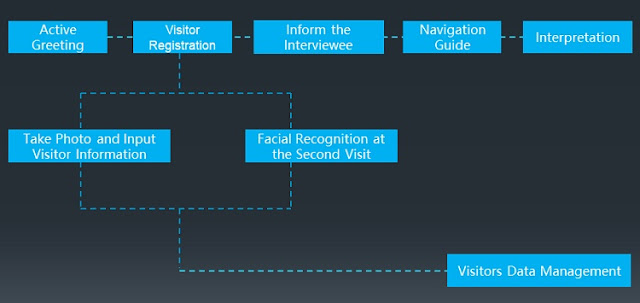
Visitor Reception

When a visitor is at the entrance to your company, Sanbot Max will greet them:
Sanbot Max: Hello, what can I do for you?
Visitor: I want to visit Jack.
Sanbot Max: I need to register you; may I have your name?
Visitor: My name is Lee.

During the recording process, Sanbot Max will capture a photo of the visitor and input both the visitor’s photo and name into its system. Next time the visitor arrives, Sanbot Max’s facial recognition technology enables the advanced robot to greet them, “Lee, what can I for you?” With visitors being a part of a company’s the Big data, the company administrator can easily manage, collect, and analyze these statistics.

Sanbot Max will call the staff member via the Sanbot Q-Link mobile APP. The staff member can ask Sanbot Max to take the visitor to the conference room, or say they do not have time to see the visitor. Equipped with advanced 3D vSLAM technology and obstacle avoidance sensors, Sanbot Max will take the visitor to the conference room. The robot can also give the visitor a tour of the company.


Administrative Management

Sanbot Max is the great assistant for administration management by taking the basic management and repetitive work. Sanbot can record all of your staff’s information (photo, name, contact) into the system and never lose the information as well as keeping that information extremely safe. Staff members can look through the contact list to familiarize themselves with any new employee. After the staff’s information is inputted into the system, Sanbot Max will help check in and check out staff members, keeping a comprehensive and accurate attendance record.

Remote Services

Whether Sanbot Max is using its 3D vSLAM function or being controlled by the mobile app, Q-Link, Sanbot Max can patrol and monitor your company 24/7, and you can instantly see what Max sees through the app. This will help ensure your establishment is not in any danger. And, Q-Link enables absent personnel to interact with Sanbot Max and people at the office, making sure no one misses a meeting.


Data Management and Application

Sanbot Max is able to collect and store all the visiting records into its system, and it will form comprehensive graphs and records (one month, one quarter or one year). For example, the administrator can check on one employee’s attendance record and make an analysis on their working status; the purchasing manager can analyze the supplier’s visiting record to see if there is anything abnormal happening to the supply chain, and more.

This solution is not the only solution for businesses. With an open API, Sanbot Max can be further developed and applied into more working scenarios: 4S shops, sales centers, government buildings, shopping malls, banks, hotels, exhibition halls, etc. Sanbot Max’s professional and all-round skills simplify the customer reception and internal management, reducing labor costs, creating business value, reducing operating costs, and improving the enterprise’s image.

If you are a robotics solution developer, system integrator or AI agent, this is the time for you to join the Sanbot family.

Wednesday, December 13, 2017

The present robotic services for retail, and will be better

In a large shopping mall, especially the complex one, people are always unfamiliar with it but they need to find the right brand or product they need. Thus, customer receptionist is necessary. A problem is coming: repetitive work makes receptionist tired and bored so they may lose temper to customers. Then, an intelligent service robot that never feels tired makes things different.

A robot’s powerful artificial intelligence brings a great number of services for welcome reception, route guidance, all-around inquiry assistant, smiling accompanying assistant and more.

The robot standing around the door of the shopping mall attracts potential customers to go into the mall. With facial recognition technology and smart sensors, Sanbot broadcasts pleasing welcoming lines, giving customers different experience and adding buying intention. This will add unexpected business sales and value to the shopping mall.

The mall managers can the robots for retail in each floor. These robots introduce customers to the commodity area by voice, or display the map on the screen to the customer guide. When customers want to know a brand, or looking for a product, they just feel free to inquiry the robot. It’s a more convenient way than manual services because human staffs are not always in good situations to serve customers 24/7.

When the mall held a large-scale promotional activity, the commercial service robots can also play an important role, such as the singing and dancing performance, talking comic dialogue with the site voice interaction, inviting them to participate in the lucky draw, somatosensory games to attract onlookers. This will popularize the mall or store and develop more potential customers.